The First Spheres
The first speakers were developed as part of Perry Cook and Dan Trueman's N-Body project at Princeton University, which studied the emanation of sound in different directions from a variety of musical instruments. The first working models included the full-sphere Bomb and the Boulder. A slightly later version included R2, a spherical speaker built from Ikea salad bowls.
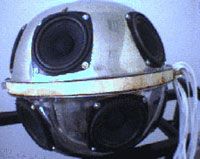
The Bomb
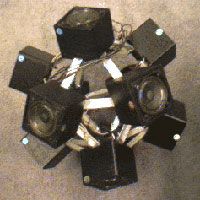
The Boulder
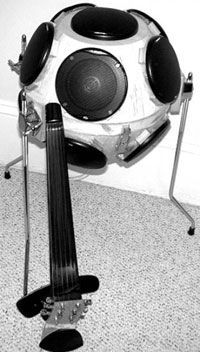
R2 — built from Ikea salad bowls
First Generation Performance Speakers
After several permutations, the first generation of performance-ready spherical speakers was built. A dodecahedron (12-sided) cabinet was designed by Dr. T. Laurence Trueman and Dan Trueman. Several instruments were developed from it, including Dan Trueman's Critter speaker and Curtis Bahn's large Bubba speaker. These were integrated into Trueman's Bowed Sensor-Speaker Array (BoSSA) and Bahn's Sensor Bass R!g, respectively.
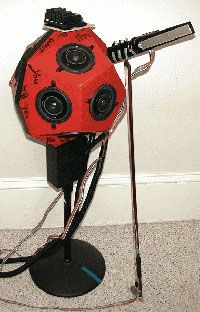
Critter
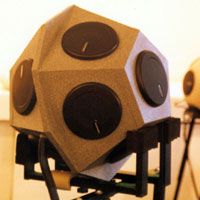
Bubba
Second Generation
The second generation of spheres, developed by Trueman and Bahn, featured truly spherical cabinets designed and fabricated by Universal Enclosures. While this design solved many problems of construction, it proved problematic in other ways — such as the difficulty of mounting speakers tightly to a curved surface.
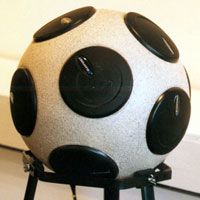
Second Generation
Third Generation — The First Hemispheres
Returning to the Trueman design for inspiration, hemispherical speakers were developed which could be fastened together into a sphere or used as separates. A major project was undertaken at Rensselaer Polytechnic Institute by Professor Curtis Bahn, assisted by graduate student Stephan Moore, to build a large quantity of these speakers.
Not only are these the first actual Hemispheres — they are also the first to use Polk Audio drivers, a relationship that continues to this day. The cabinets are built from MDF and painted with glossy black enamel at an auto body shop. In all, fifty-five third generation Hemispheres are built in the first eight months of the year.
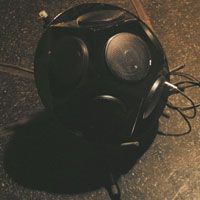
Third Generation
Fourth Generation
The fourth generation of Hemisphere develops a cult following, with a small but growing cadre of musicians, artists, and composers using Hemispheres in their performances and installations. Stephan Moore begins manufacturing new hemispherical speakers, and master furniture maker Ken Malz is enlisted to build the speaker cabinets. Malz and Moore make several incremental improvements to the design, including larger high-quality Polk Audio speaker drivers, rounded edges, and a durable finish.
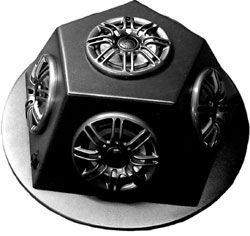
Fourth Generation
The Princeton Laptop Orchestra
The Princeton Laptop Orchestra (PLOrK) is formed by Dan Trueman, Perry Cook, Ge Wang, and Scott Smallwood. For their performers' setup rigs, they develop a modification to the 4th Generation Hemisphere that allows the individual speakers to be addressed independently, turning each into its own six-channel speaker array. Moore incorporates the Princeton design and begins building both mono and six-channel Hemispheres.
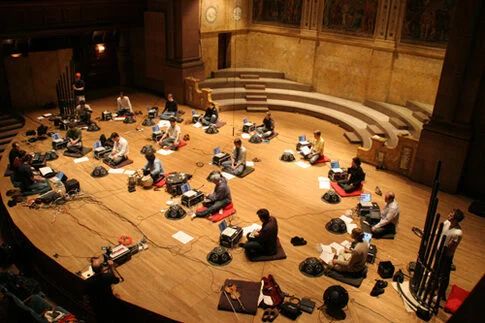
The Princeton Laptop Orchestra
Electrotap & the Floating Points Festival
Moore begins an important partnership with Electrotap, an online company run by Jesse Allison and Timothy Place — makers of the Teabox sensor interface, Tap.Tools extensions for Max/MSP, and other hardware and software products. Through this internet retail outlet, Hemispheres begin to reach a much wider audience.
2006 also sees the first Points in a Circle Festival at Brooklyn's Issue Project Room, featuring a month of performances designed for their sixteen-channel array of 3rd Generation Hemispheres. The festival becomes an annual event, changing its name in 2008 to the Floating Points Festival.

Electrotap
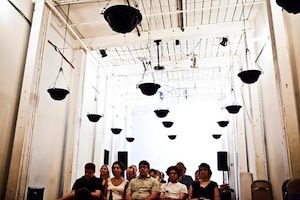
Floating Points Festival, Issue Project Room
Fifth Generation & the PLOrK Aluminum Hemispheres
Sales of Hemispheres through Electrotap continue, and further design modifications are made — including the introduction of handles in the base flange and an update to the Polk speaker model.
Meanwhile, the Princeton Laptop Orchestra receives a large grant from the MacArthur Foundation and uses it to develop a unique flangeless variation made entirely of brushed aluminum, with internal amplifiers and a six-channel audio interface mounted on the bottom. These are the first self-powered Hemispheres — highly portable all-in-one voiceboxes for the laptop musician.
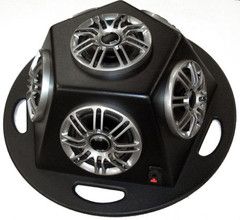
Fifth Generation
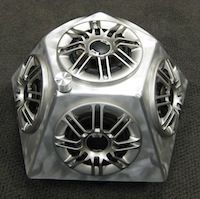
PLOrK brushed aluminum Hemisphere
Powered Hemisphere Research
Hemisphere production slows and then goes on a hiatus while Stephan Moore moves to Pawtucket, RI and begins to research affordable amplifier technologies to install in a new generation of powered Hemispheres. Inspired by a commission from Irish composer Alex Dowling, the project eventually takes 18 months, working in conjunction with the China-based company Helder Hifi.
Isobel Audio is Born
In April 2012, Isobel Audio LLC is formed, and sets up shop in Pawtucket. New Alto and Baritone models are unveiled at the first Symposium for Laptop Ensembles and Orchestras (SLEO) at Louisiana State University. Each of the new sixth generation Hemispheres operates as both a mono and six-channel loudspeaker, available in powered and passive versions.

Moving and Modernizing
Isobel Audio HQ moves to Chicago. As operations shift to the Midwest, new collaborators join the team: Musician and electronics wizard Daniel Fishkin designs a new amplifier electronics package that provides a much improved interface for the powered speakers. Noah Modie and his team at Oxbow Design Build (of Easthampton, MA) take over the design and manufacture of the powered speaker cabinets.
The Seventh Generation & CLEAT
After more years of development, the seventh-generation Hemispheres are born — Isobel's best speakers yet. These speakers become the centerpiece of the Chicago Laboratory for Electro-Acoustic Theater (CLEAT), established by multichannel sound lovers Sam Clapp, Stephan Moore and Matt Test. Their sixteen-channel system of Hemispheres takes up residence with a monthly concert series at Elastic Arts Foundation in Chicago's Logan Square neighborhood, offered as a community resource for the city's thriving experimental music scene and beyond.

Nearly 30 Years
Isobel Audio looks back on nearly 30 years of speaker-making history — from a Princeton research lab to stages, galleries, and laptop orchestras around the world. The Hemisphere continues to evolve.
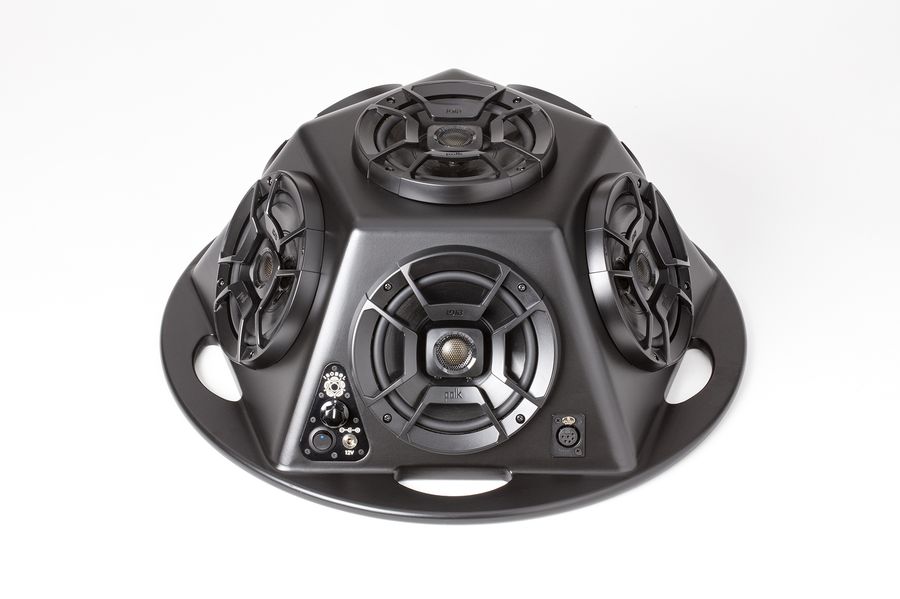
The Seventh Generation Hemisphere